PPT Studio
Approved content → editable PPTX- Receive approved content
- Choose template / KV
- M×T match · 3 drafts · layout
- Preview → adjust → .pptx
Case 01 · AI Product System
Design stopped being a queue.
Choose an approved template.
Create in conversation. Review in context.
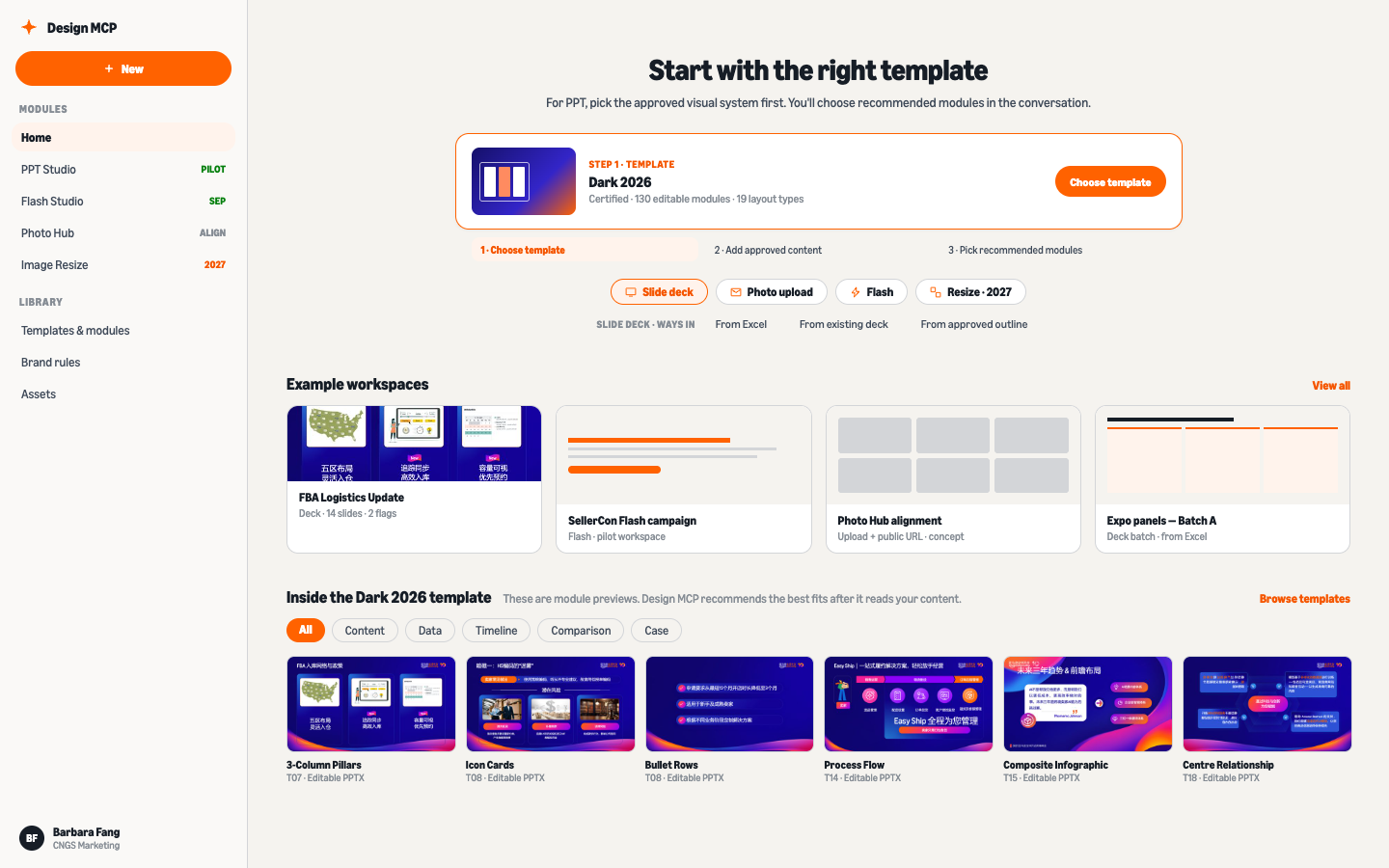
A governed platform that turns approved content into brand-compliant, editable and localized output, without putting a designer in every routine production loop.
One entry, four governed workflows, one shared constraint layer.
Amazon Global Selling China produces seller-facing decks, campaigns and event materials continuously. Everything routed through a small central design team, so the queue set the pace instead of the idea.
Making slides was never the hard part. The problem was how approved content becomes compliant, editable and localized output without the brand drifting one request at a time.
Design MCP is a Model Context Protocol server that holds the design system as executable capability — brand rules, certified templates, module libraries, rendering and QA — and exposes it to any AI client. PPT Studio, MUSE for HTML email, Adaptive Creative and the shared Image Library are four product paths that call the same server.
Why MCP rather than an API or a shared Skill:
Every product has to integrate and adapt the design system separately. Four products, four integrations, four places rules drift.
A shared skill is a snapshot of "how we do it", scattered across agents. Once shared, nobody owns the copy; it expires quietly.
The latest brand rules, templates, render and QA live in one model-agnostic mechanism. Skills only guide when to call it. Every AI client reuses the same design system, always current.
I own the product definition, interface, template systems, validation rules and the operating model that connects design, engineering, vendors and business teams.
Brand rules are versioned centrally, so one update propagates to the organisation instead of being re-explained for every request. Each workflow inherits the same logic for approval, QA and human intervention.
My role moved with the system: from taking design requests to owning the standards the system enforces.
Approved content → certified template → editable PPTX. Pilot, real-material validation.
The seller conference creates three different deck problems. Approved Chinese sessions need full template application. Global English keynotes need format conversion and image sourcing, while translation stays with its owner. Exhibition content arrives as a spreadsheet that one person currently spends about three days hand-placing into a 100-page deck.
Content routes to one approved template and a library of 130 certified layout modules. If copy does not fit, the system chooses another layout or returns the content—it does not shrink the type until the problem disappears.
Every page clears both structural collision checks and a 200% rendered visual review. This module is in real-material validation.
PPT Studio · product user journey
Step 1 · Content side
CommSphere · Pitch Deck Gen · Maven
Step 2 · Content side
CommSphere · Pitch Deck Gen · Maven
Step 3 · Design side
Design MCP
Step 4 · Design side
Design MCP
Step 5 · Design side
Design MCP
Step 6
Four quality gates + one two-way choice · no presumed savings numbers
Main path · PPT Studio · pilot Oct 2026
Every path starts on this hub. The certified Dark 2026 card sits at the top; the chips underneath are the other ways in — Photo upload, Flash, Resize · 2027.
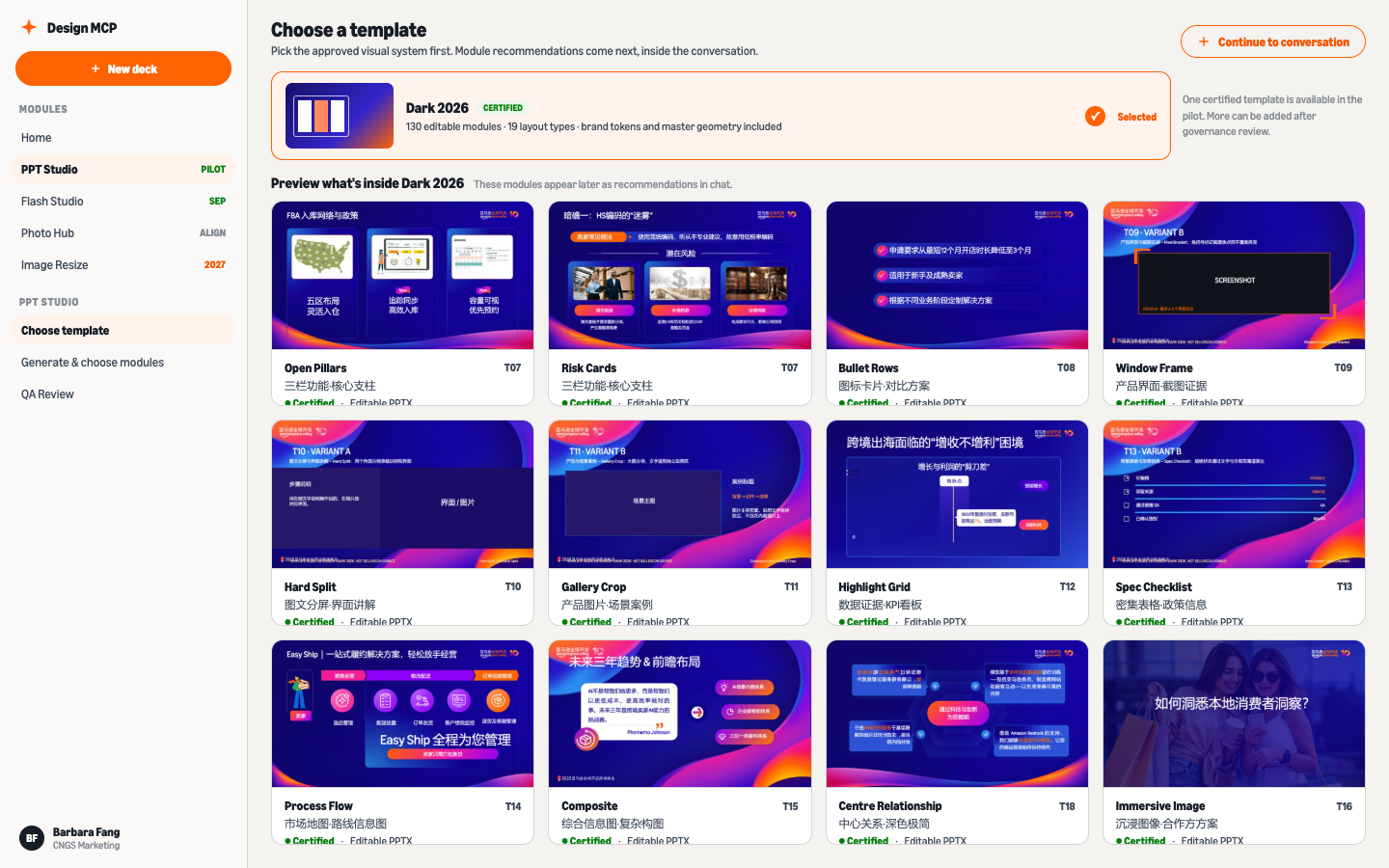
The template library opens with Dark 2026 ready to inspect.
One certified visual system in the pilot: 130 editable modules, 19 layout types. The previews show what Dark 2026 contains before you commit.
A workspace conversation opens with the template locked in.
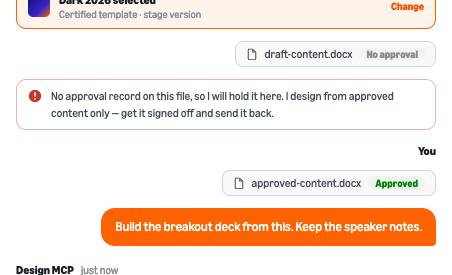
draft-content.docx has no approval record, so it is held with a plain answer. Nothing renders from an unapproved draft.
Upload approved-content.docx and say what you need — the flow continues from the approved file only.
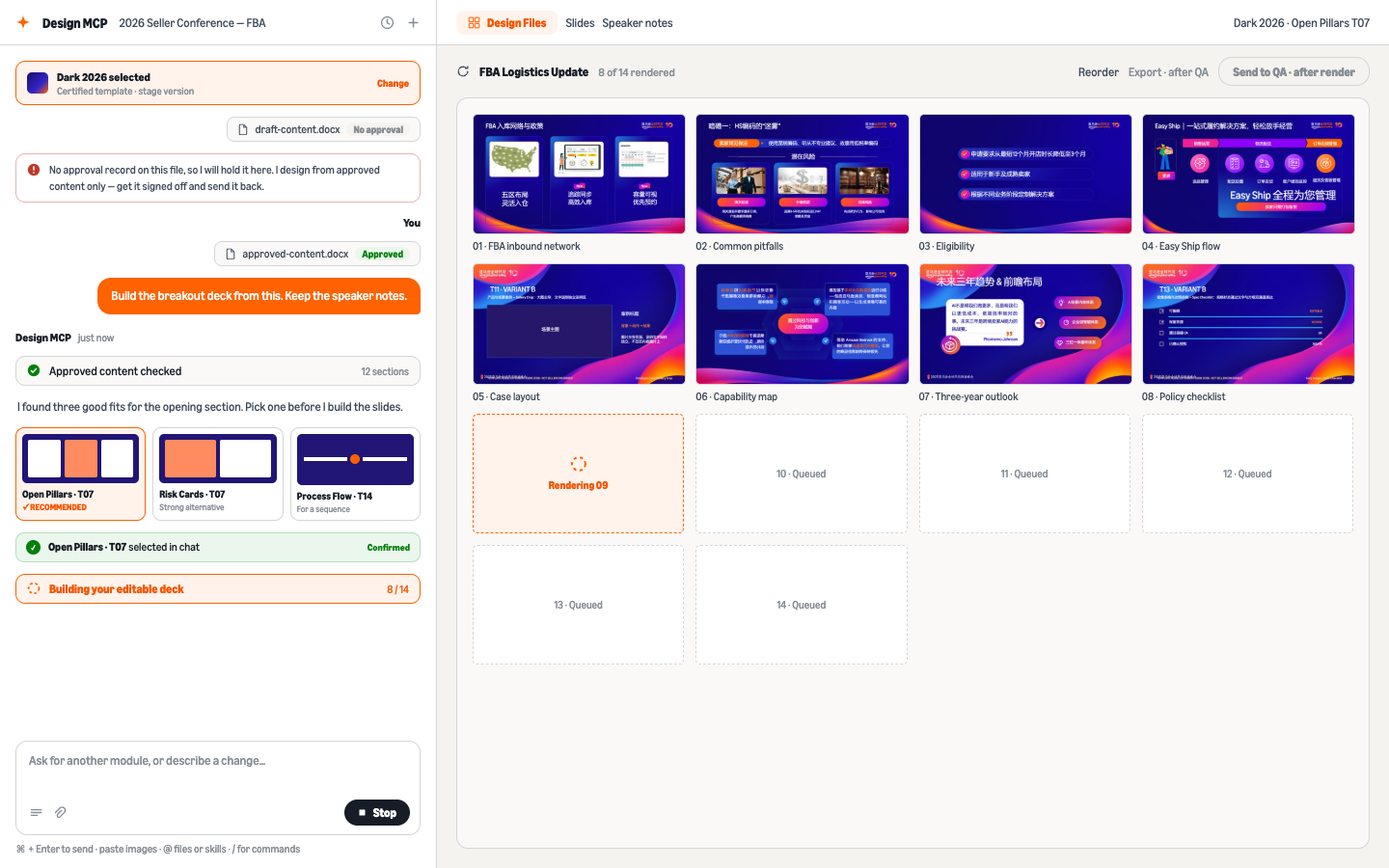
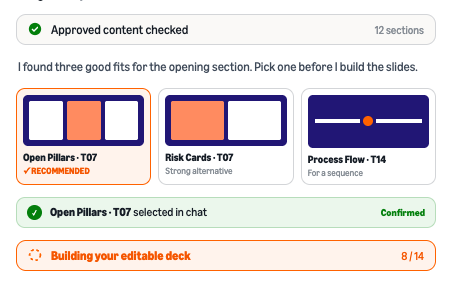
Design MCP reads the 12 approved sections and recommends three fits for the opening. Click Open Pillars · T07 to confirm.
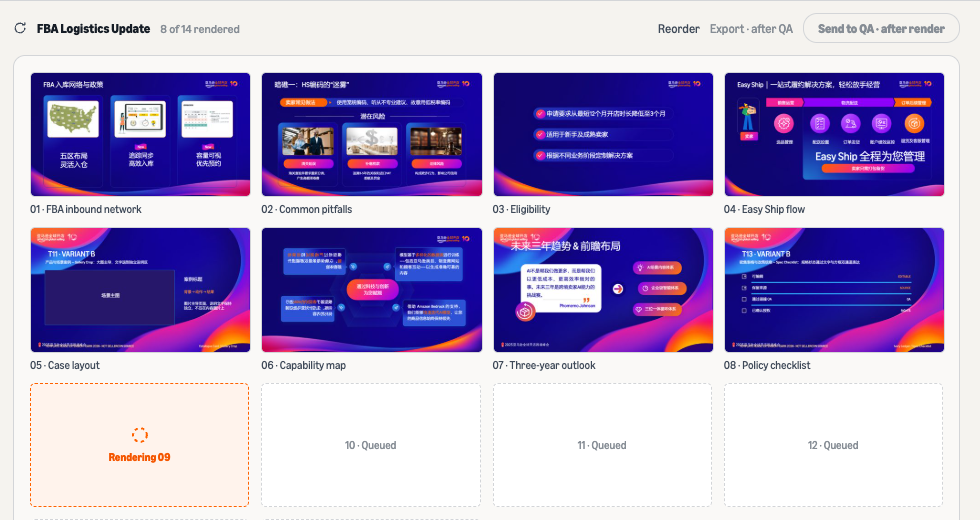
The editable deck starts building — 8 of 14 slides and counting.
Slides land in the Design Files panel as they finish — rendered, rendering, queued. The button stays greyed until every slide is in.
Send to QA unlocks only after render — click it and QA runs in the same thread.
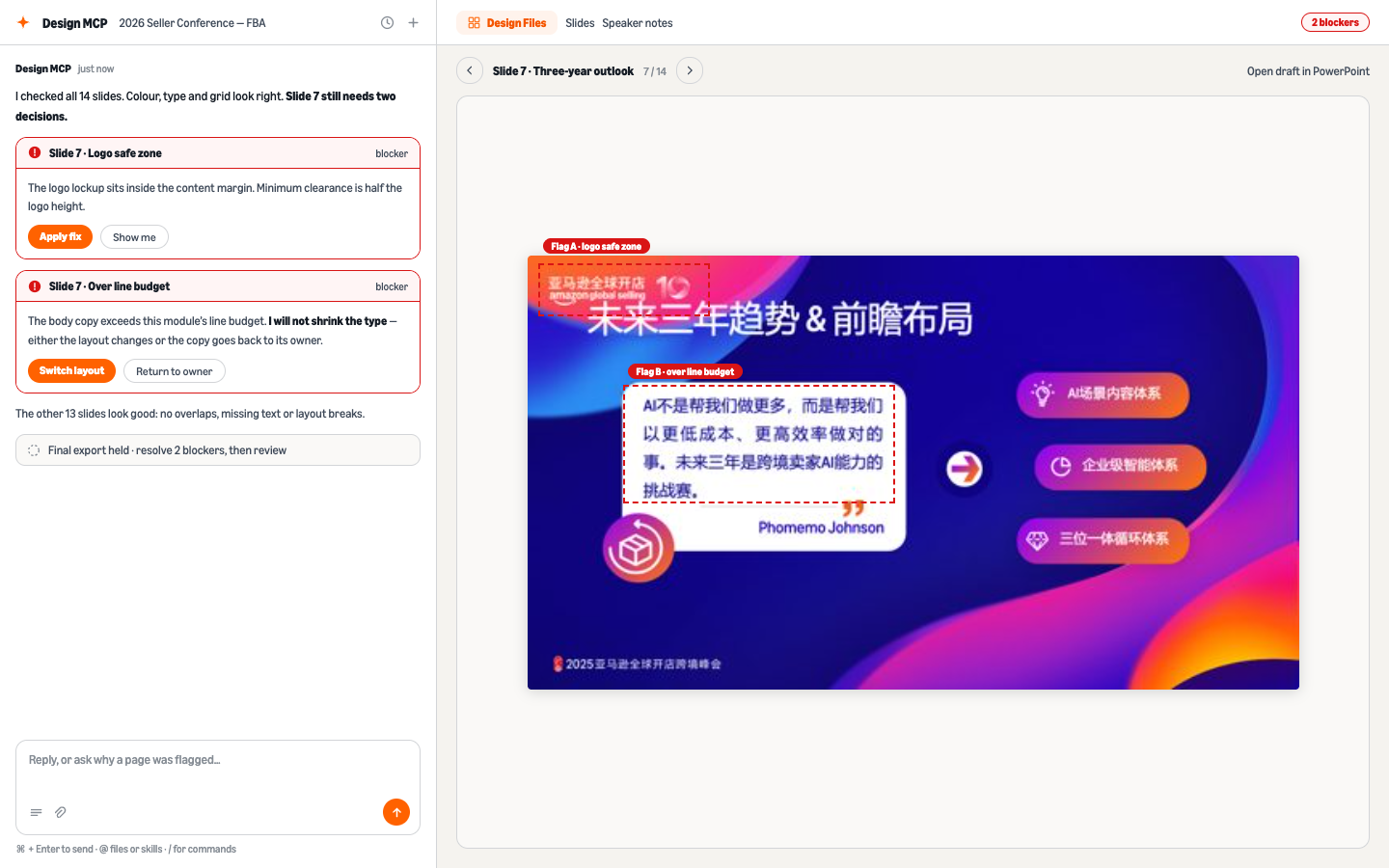
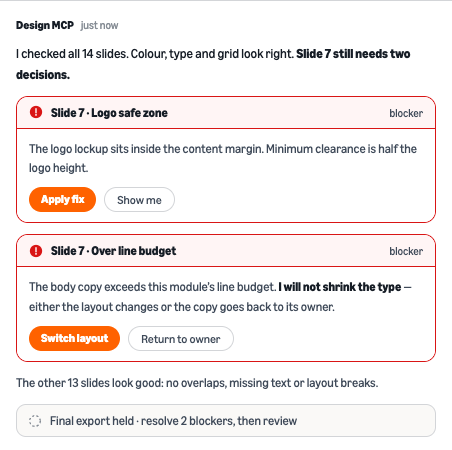
QA checked all 14 slides; only slide 7 blocks. Click Apply fix for the logo safe zone. For the copy over budget, choose Switch layout — or return it to its owner.
The system never shrinks type to force a fit. Fit problems change the layout or go back to the content owner.
Native PowerPoint objects, speaker notes kept, brand tokens intact. It opens in PowerPoint as a working file, not a flattened export.
Marketing User Interface & Style Engine — takes raw content and produces on-brand, production-ready email HTML, doing the job of both a designer and a front-end coder.
The channel team owns the full email lifecycle for 800K sellers — roughly 600 emails a year. Two steps had become the bottleneck: a designer or agency hand-coded every email in 6–8 hours, then a specialist worked through about 80 manual setup steps before it could be sent. Slow, an agency cost, and only a few people could do it.
MUSE takes the first job. A marketer uploads a plain Word doc; MUSE lays it out on-brand and writes cross-client production HTML in 30–60 seconds. No designer or vendor in the loop. Deployment is handed to ECHO, an RPA operator that turns the ~80 Pardot steps into two clicks.
Production-grade rather than a generic AI draft, because a senior design team's judgment is built into the engine and applied to every email.
Live on real seller campaigns since May, not a proof of concept. Announced to CNGS Marketing in August 2026.
Design know-how now sits in the system rather than with one specialist, so any marketer can send a production email on their own.
A marketer starts with approved campaign copy in Word. MUSE turns it into production-ready HTML in 30–60 seconds, using a controlled module library instead of an open-ended visual generator.
Judgment stays with people. What leaves the queue is routine layout and coding, while creative approval and brand governance remain visible.
 View complete email ↗
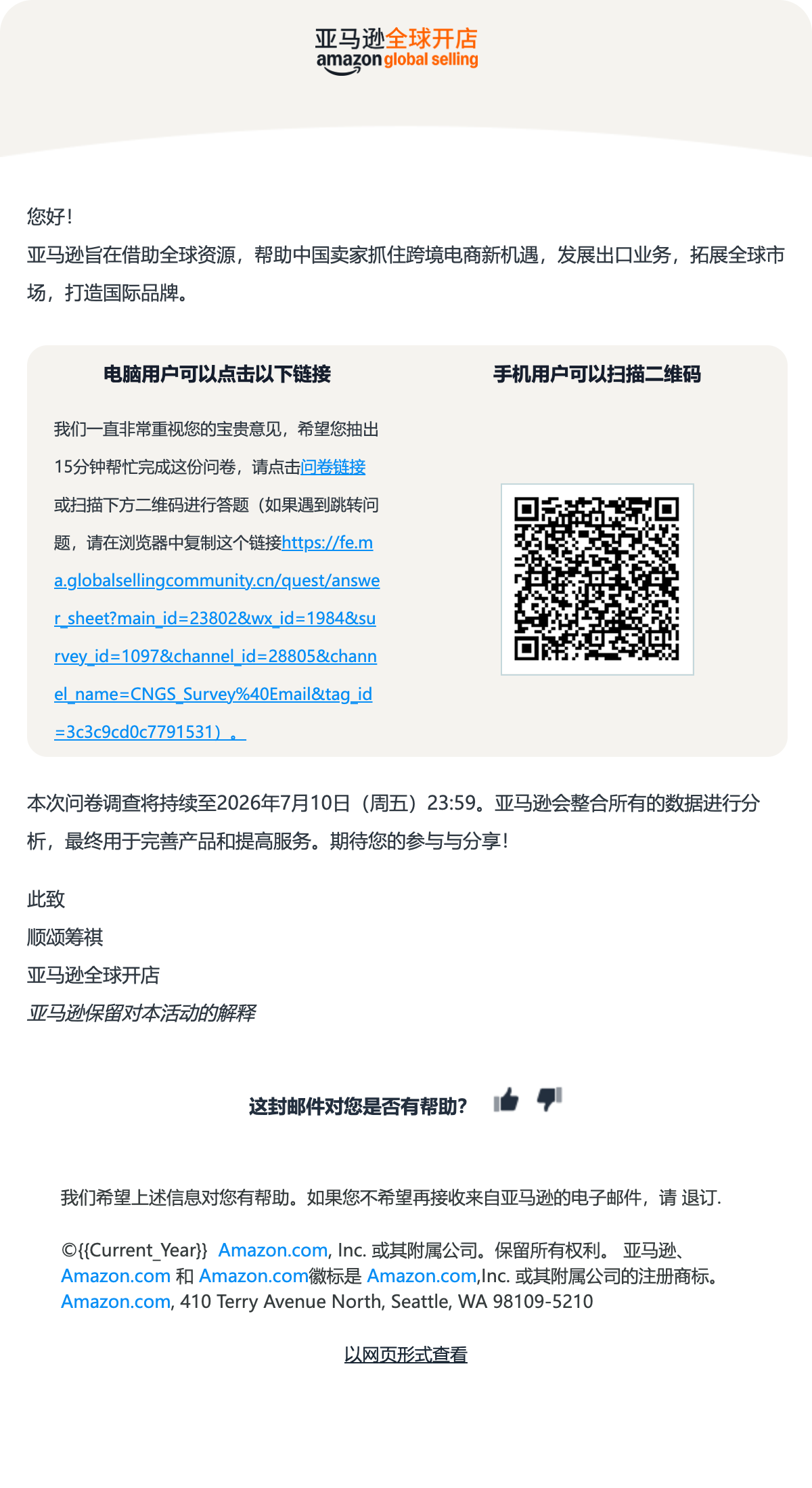 View complete email ↗
 View complete email ↗
Captured from the supplied HTML files, including every section and footer. Template variables are shown as supplied; the newsletter’s recipient-specific QR image requires send-time data.
MUSE 1 produced one on-brand email per campaign. MUSE 2 produces one email per seller, with content written by an AI engine every business day. Live since September 2026, it connects MUSE to MAVEN, the seller-launch personalization program.
The biggest change was upstream: the content creator moved from a person to an agent. In MUSE 1, people prepared content in Word, where headings, paragraphs, lists, and emphasis already carried the intended structure. In MUSE 2, the content agent writes each seller’s email into one row of a sending list. The challenge was therefore agent-to-agent handoff: how could the design agent pass its email modules to the content agent through a plain-text spreadsheet cell, reliably across thousands of rows?
I solved this with a compact semantic contract: seven tags for title, preview, salutation, body, sub-heading, list, and button, plus two inline markers for emphasis. I packaged the contract as a skill for the upstream content agent, enabling it to generate seller-specific content in a structure that maps directly to MUSE’s design modules. A deterministic parser then renders every row using the same brand and layout rules. No model runs at send time, so the output remains consistent while the content stays personal to each seller.
The green status opens the checks behind the selected email’s QC result.
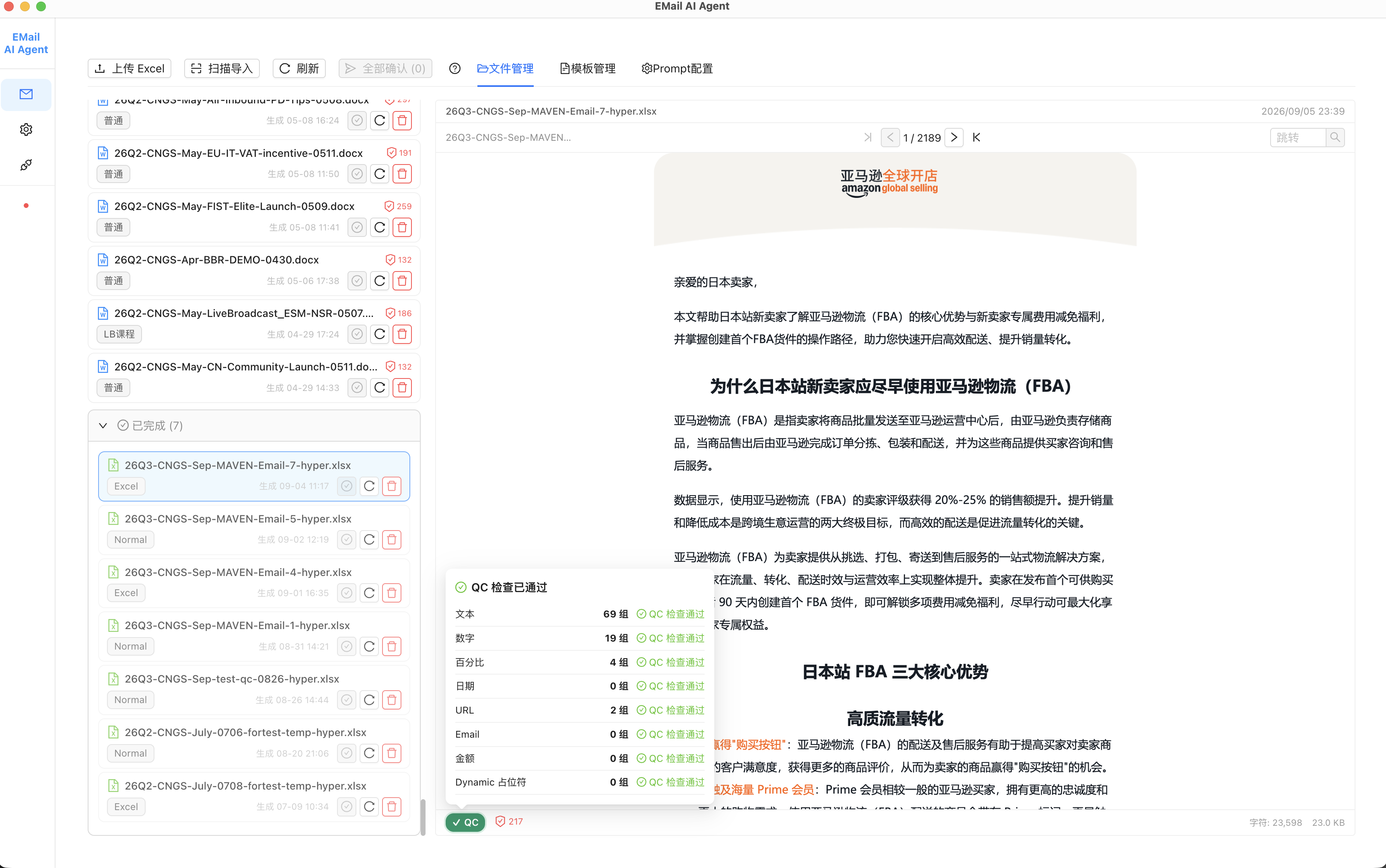
Also checks dates, email addresses, amounts and dynamic placeholders.
content cell → one email.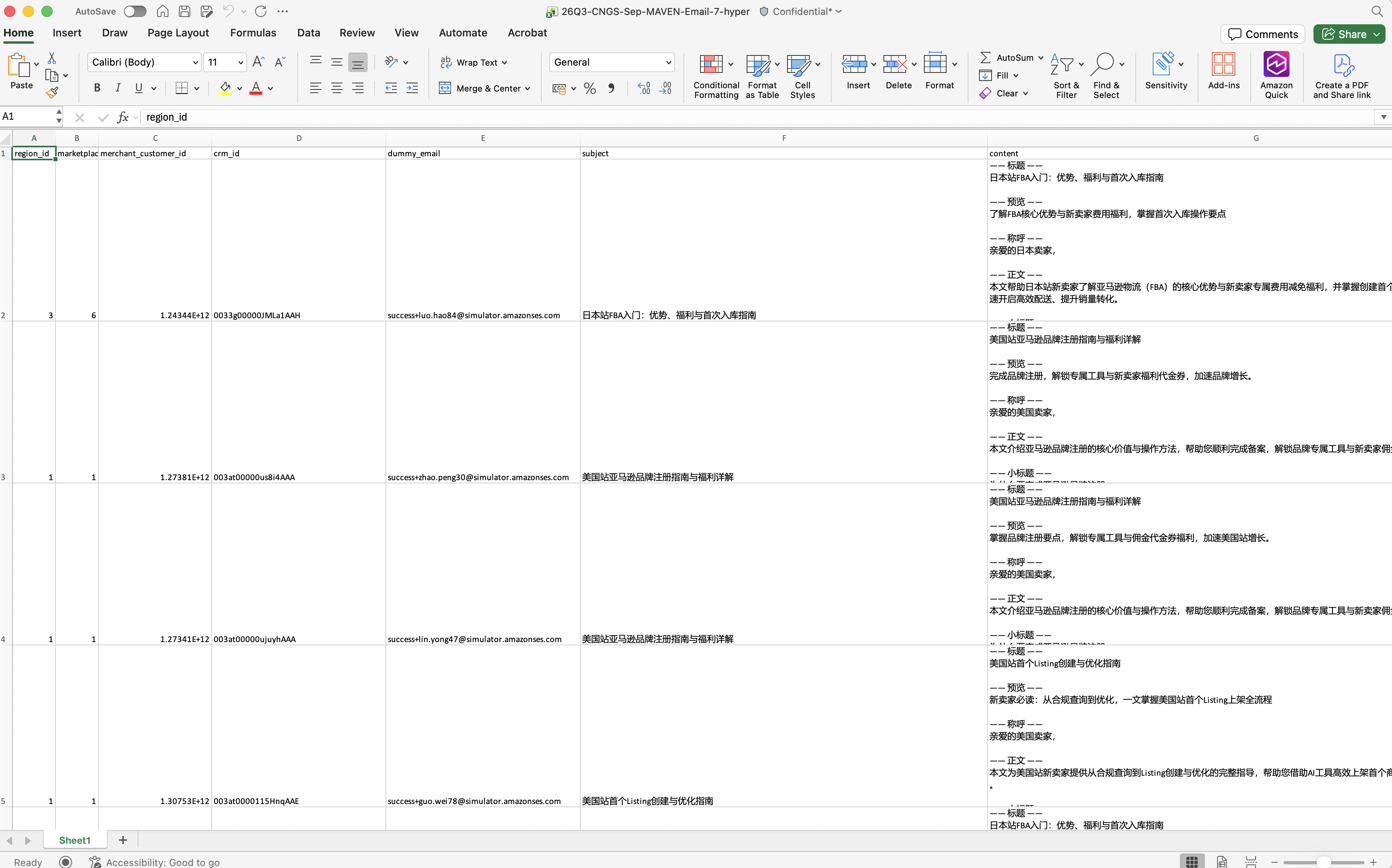
Workbook overview · column G highlighted
contentColumn G · detailcontent column. Original Chinese copy is preserved.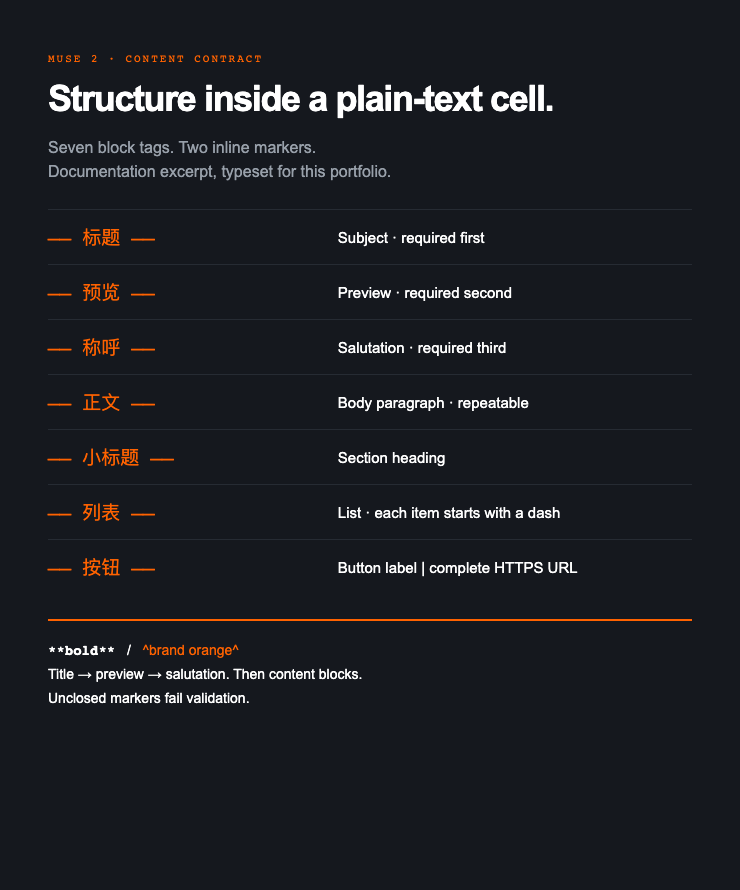
We built an independent QC step into the live pipeline. It checks that every rendered email faithfully preserves its source content before it can be sent.
MUSE 2 is the piece that turned MAVEN's email channel from a concept into a daily send. MAVEN can write per-seller content; without a deterministic HTML generator, no row of it becomes a brand email a seller can receive.
Quality holds by rule rather than by a designer watching. Next: the same contract extends to tables, images and per-seller links.